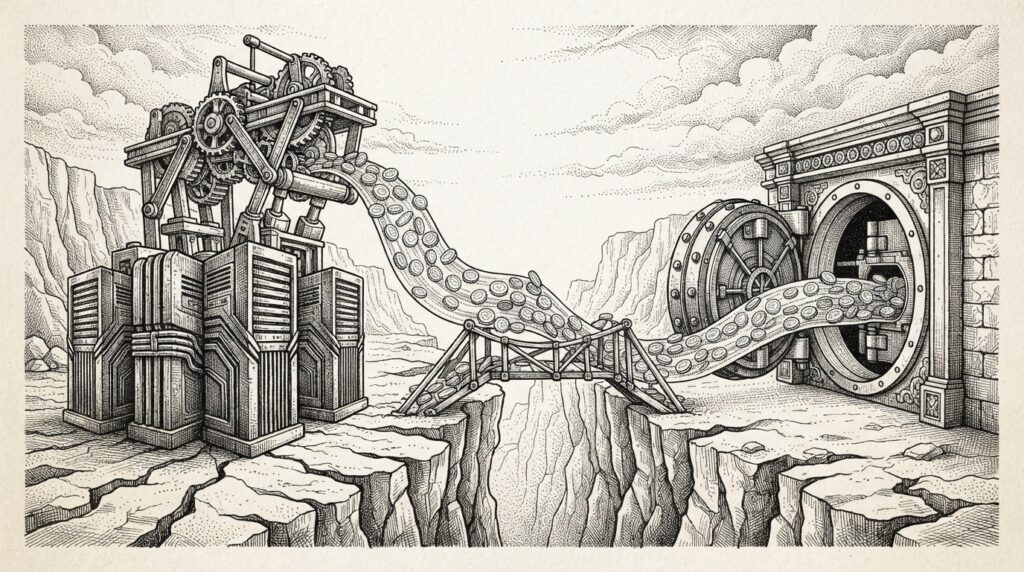
The conversion of physical compute into on-chain liquidity relies on a specific mechanical stack: GPU Warehouse Receipt Tokens (GWRTs). These are UCC-governed digital receipts representing verified ownership of physical hardware, minted via USD.AI’s modular tokenization primitive, CALIBER. By treating GPU clusters as collateral, the system allows borrowers to access USDC stablecoin liquidity at 70-80% loan-to-value ratios. This architecture effectively classifies GPU compute as an emerging ‘exogenous’ physical Real World Asset (RWA), placing high-performance hardware alongside traditional commodities and real estate within the broader taxonomy of tokenized collateral.
The underlying USDai stablecoin maintains its peg through a separate mechanism, backed 1:1 by short-duration U.S. Treasuries via the M0 protocol. This creates a bifurcated structure: the lending facility is collateralized by the volatile, depreciating physical asset, while the stablecoin itself remains anchored to the relative safety of sovereign debt. It is a clever, if capital-intensive, attempt to bridge the gap between the physical requirements of the AI boom and the liquidity constraints of the crypto ecosystem.
Bullish (NYSE: BLSH) has committed $100 million in liquidity to this facility, bringing a level of institutional oversight that is, frankly, a departure from the typical RWA experiment. As a NYSE-listed, NYDFS-regulated, and FinCEN-registered entity, Bullish operates under a complex web of international frameworks, including BaFin in Germany, the SFC in Hong Kong, and MiCAR in the EU. With $30 billion in spot trading volume as of May 2026 and a network of over 1,000 institutional counterparties via Paradigm, the firm’s involvement signals that this is not a retail-facing novelty, but a serious attempt at institutional capital deployment.
The precedent for this model was established in October 2025, when QumulusAI secured a $500 million non-recourse financing facility via USD.AI for up to 70% of its GPU deployments. The fact that this model has already seen such significant capital allocation suggests that the infrastructure for tokenizing physical compute is maturing, moving beyond simple financial assets like Treasuries and credit into the realm of tangible infrastructure.
However, the transition from digital to physical collateral introduces significant friction. Unlike a Treasury bill, a GPU is subject to rapid depreciation through obsolescence and wear, and liquidating physical hardware is a logistical nightmare compared to selling a digital asset on an exchange. USD.AI attempts to mitigate this through FiLo, a decentralized underwriting mechanism with first-loss alignment, and QEV, a liquidity sequencing mechanism derived from amortizing repayments. The technical risk here is that FiLo’s first-loss alignment may prove insufficient if the secondary market for used GPUs collapses simultaneously with a broader market downturn, while QEV’s reliance on amortizing repayments assumes a steady cash flow that may not materialize if the underlying compute demand shifts abruptly.
Bullish is also testing the secondary market for sUSDai, the yield-bearing variant of the USD.AI stablecoin. By onboarding sUSDai across multiple trading pairs with a dedicated market-making program, Bullish is effectively stress-testing the liquidity of this new asset class. This follows a broader trend of institutional interest in stablecoin utility, echoing recent pivots by Ethena and the ongoing developments within the Bank Stablecoin Consortium.
Following the announcement, Bullish shares rose 3.90% to $24.54, a modest rebound toward its 52-week low of $20.55. While the market reaction was measured, the structural implications are clear. By bridging the gap between physical compute infrastructure and on-chain liquidity, Bullish and USD.AI are attempting to solve the capital intensity of the AI boom.
If the model scales, it may provide a viable blueprint for how other physical assets are brought on-chain, provided the legal and physical liquidation risks can be managed at scale. This remains a conditional technical hypothesis; the success of the model depends entirely on whether the underwriting and liquidity sequencing mechanisms can survive the inevitable volatility of the physical hardware market.