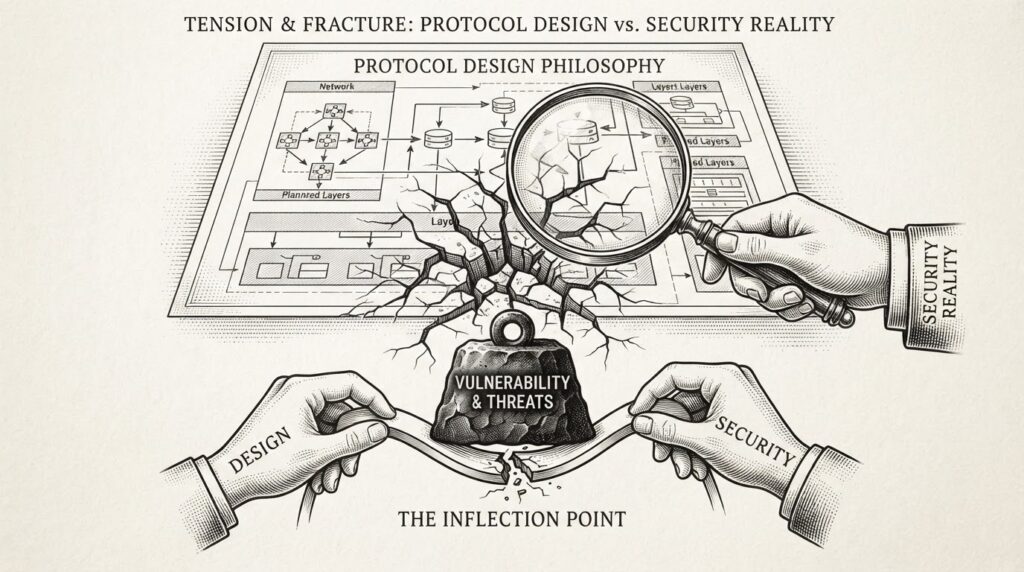
The Seoul Inflection Point
More than 21,000 internet-facing MCP server instances are currently exposed, with nearly 92% of audited production servers lacking basic OAuth authentication. This data, surfacing alongside a growing catalog of critical CVEs and the formalization of the OWASP MCP Top 10, has transformed the Model Context Protocol (MCP) Dev Summit in Seoul this August 13–14, 2026, from a routine industry check-in into a high-stakes confrontation. For the first time, protocol designers and the security community are meeting in person to address a vulnerability landscape that has shifted from theoretical risk to systemic reality.
The rapid adoption of MCP — a protocol designed to standardize how AI models interact with local and remote data — is colliding with a series of high-profile security disclosures. The core of this tension lies in a fundamental disagreement over the protocol’s architecture, specifically regarding the STDIO transport model.
The Architectural Divide
The OX Security ‘Mother of All AI Supply Chains’ report, published in April 2026, identified what it termed a systemic architectural vulnerability in the MCP STDIO transport. The findings were significant: 150 million downstream package downloads were potentially affected, with over 7,000 publicly accessible MCP servers and up to 200,000 vulnerable instances identified. Despite these findings, Anthropic has maintained that the STDIO behavior is ‘by design,’ asserting that the execution model serves as a ‘secure default’ and that input sanitization remains the responsibility of the developer.
This position has been met with mounting evidence from the security community. Research published in arXiv 2608.00150 ‘Exposed by Design’ in July 2026 detected over 21,000 internet-facing MCP server instances. Of the 640 production servers audited, 91.8% lacked OAuth, and 687 instances were found to have unrestricted shell tool access. These figures are compounded by a growing list of vulnerabilities, including over 10 critical or high-severity CVEs and the emergence of the OWASP MCP Top 10, which highlights risks ranging from token mismanagement to tool poisoning.
Governance and the Path Forward
The shift of MCP governance to the Linux Foundation under the Agentic AI Foundation (AAIF) provides a new, neutral venue for these discussions. Previously, the protocol’s direction was heavily influenced by its co-founders, including Anthropic, Block, and OpenAI. With the Linux Foundation now overseeing the protocol, the community has a platform where architectural decisions can be debated outside of a single-vendor veto.
The NSA’s Artificial Intelligence Security Center (AISC) has also weighed in, publishing security design considerations in June 2026 that emphasize risks related to serialization, trust boundaries, and implicit trust relationships. These guidelines underscore the complexity of the challenge: the industry must decide whether to pursue deeper architectural hardening of the protocol itself or continue to rely on developer-side workarounds to mitigate systemic risks.
The industry now faces a binary choice: commit to fundamental architectural hardening of the protocol or accept a future where security remains a perpetual, developer-side burden. The outcome of these discussions will determine whether the infrastructure powering the next generation of AI agents is built for inherent resilience or remains fundamentally exposed by design.